
Bring The Dog
The Ongoing Conclusion of Spirited Travelers, Part 2.5: The Dog Chapter

Hello, Friend ~ I’m Scott and welcome to your 5-Minute Vacation for Dec. 7th. I share these snippets of our travels in the hope that my photos and stories will allow you to “get away from it all,” if only for a moment. Thanks for welcoming me into your inbox today.
This is the continuation of the second part of the Spirited Travelers finale where I reflect on what did happen. In upcoming postcards, I’ll share some lessons learned, some favorite memories, and conclude with what’s next.
If you missed the previous 5-Minute Vacation, you can find it here.
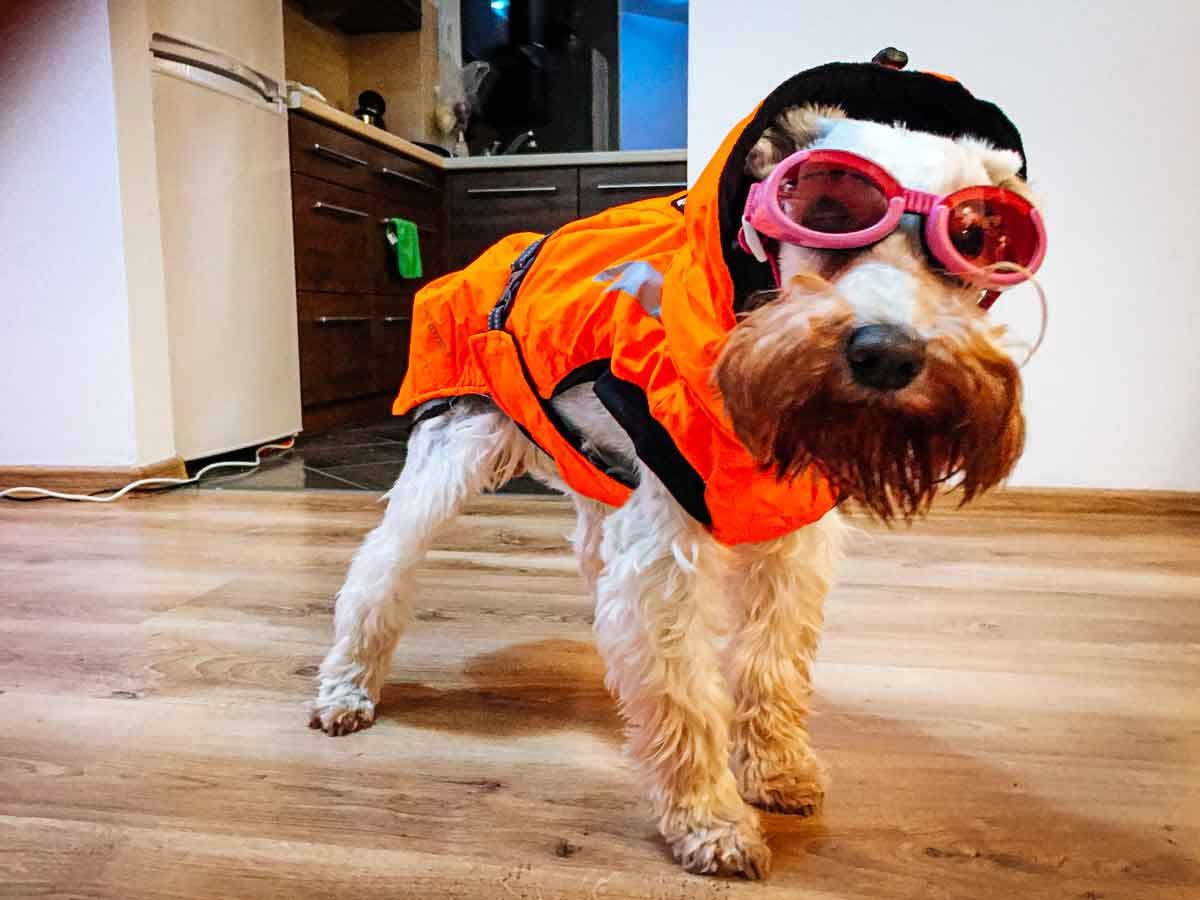
We bought Riesy a parka and doggles to help her brave the cold Słupsk winters. When we put the parka on her, she would list to one side so much that we thought she’d keel over like the Swedish warship Vasa. However, she always managed to stay even-keeled. Once outside, she forgot about the parka and romped around normally. I guess she liked that the parka kept her warm. However, she never warmed up to the doggles.
Last time, I shared how we fared with three of our four goals for living in Europe. Our fourth goal was to bring our miniature schnauzer Riesy along on our travels whenever possible. How did we do with that? Well, it’s a story.
But, as Glinda says to Dorothy in The Wizard of Oz, “It’s always best to start at the beginning.” Before we could travel through Europe with her, we had to get her to Europe. How do you get a dog to Europe?
You begin with a trip to the vet.
Dogs are required to have a veterinary examination within two weeks of entering the EU. Our regular vet had long since stopped offering those examinations because of the paperwork involved. So, in addition to the third and final set of movers packing the last of our household goods, selling our car, completing the sale of our house, and saying my goodbyes, I had to find a vet willing to complete the examination. Stressful? Yes. But with the help of our friends ~ providing extra muscle, inviting me over for dinner, etc. ~ I completed everything the afternoon before our flight.
The morning of our flight, we got up before dawn to check out of the hotel and arrive at the airport three hours before the flight, which is the minimum requirement when flying with a non-service animal. After I checked us in and tucked Riesy into her travel crate, an airline employee used about a dozen zip ties to secure her crate against accidentally opening. As the luggage conveyor belt took her away, I nervously waved to her, knowing I wouldn’t see her again until we arrived in Germany 16 hours later.
Since she was required to undergo a vet’s examination before traveling, I expected someone at the Frankfurt airport would at least check her paperwork, if not examine her. Nope. I found her unattended (but still safely zip-tied in her travel crate!) at the oversized baggage carousel. After 16 hours, I knew she had to do her business, but I had no way to cut the zip ties off her crate ~ we were in an airport after all. (Yes, 16 hours is a long time, but our vet assured us that dogs are capable of “holding it” for at least 24 hours without any problems.)
Note to self: If I ever have to do this again, pack scissors in my checked luggage.
But this time, I was scissor-less. I put her crate and my luggage on a cart and we exited into the reception area, where Rosemary was waiting for us. Poor Riesy, who hadn’t seen Rosemary in months, was wildly excited to greet her. But the zip ties held fast, and we couldn’t get her out of the crate no matter how much she barked.
After frenzied searching, Rosemary and I found a coffee booth (yes, a coffee booth before exiting the arrivals concourse!) where we begged one of the employees to lend us scissors. She wouldn’t lend them to us because we were in an airport, but she did walk over and cut the zip ties. Fortunately for Riesy, there was an unattended concrete post outside the nearest door. After that, she greeted Rosemary vigorously. Our vet was right, she was just fine.
The first two days in Germany were spent recovering from jet lag and attending to paperwork, including signing the lease for our Wiesbaden apartment. On the third day, we packed our mid-sized BMW SUV to the brim to make the 10-hour drive to Rosemary’s workplace in northern Poland. While I had brought a lot of luggage, Riesy was the real culprit who filled up our car. You wouldn’t think a 20-lb. dog would take up a lot of room, but with her travel crate, her food, a food bowl, towels, her coat, and a spot for her, Riesy took up the entire back seat.
We split the (theoretically) 10-hour drive into two days, stopping overnight just south of Berlin. I say “theoretical” because road construction and the two-lane Polish roads stretched the trip to just over 16 hours.
After settling into our first Polish house, the three of us began to explore the country: there was the trip to Hel, the trip to the largest brick castle in the world, and the trip to the seaside dunes. Riesy was a good traveler. She slept comfortably in the backseat when we were on the road, was thrilled to go on walks to explore all the new sniffs in all the new places, and she didn’t bark in the hotel rooms.
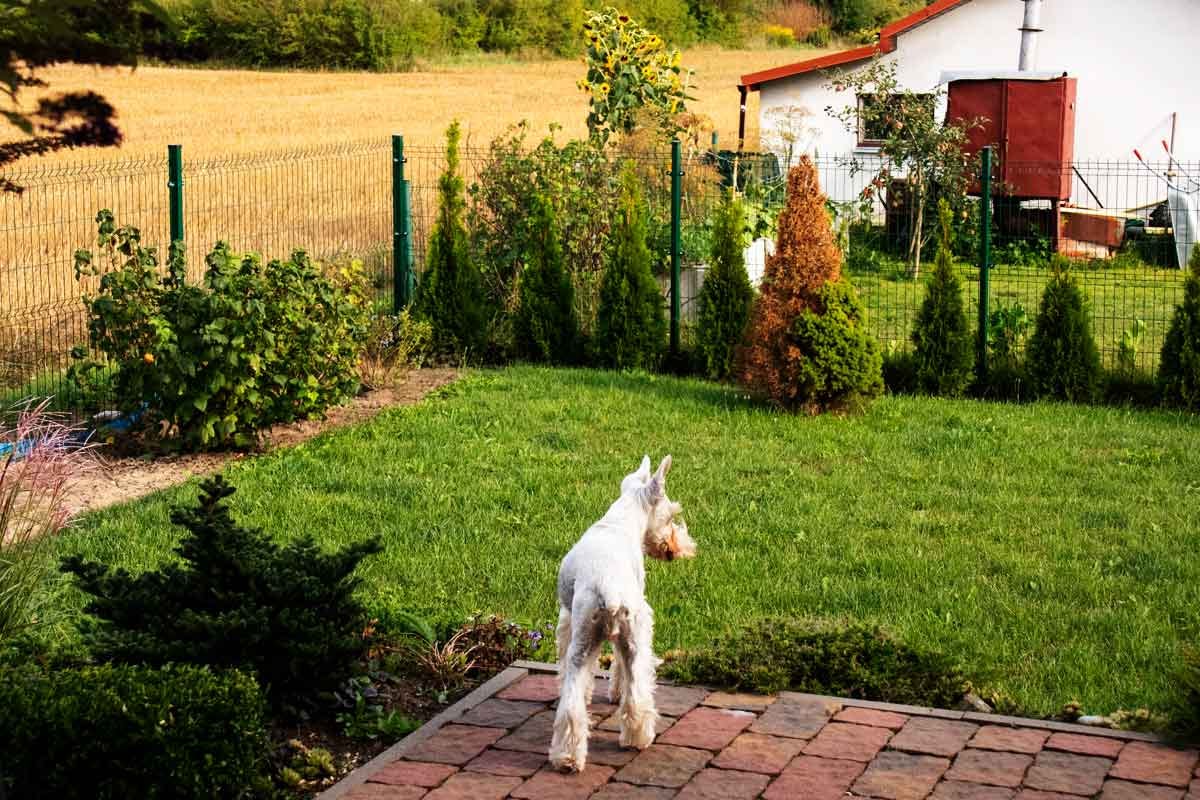
Riesy enjoyed the backyard of our first Polish house. Notice the lawn ~ we hadn’t realized that Poland was so lush.
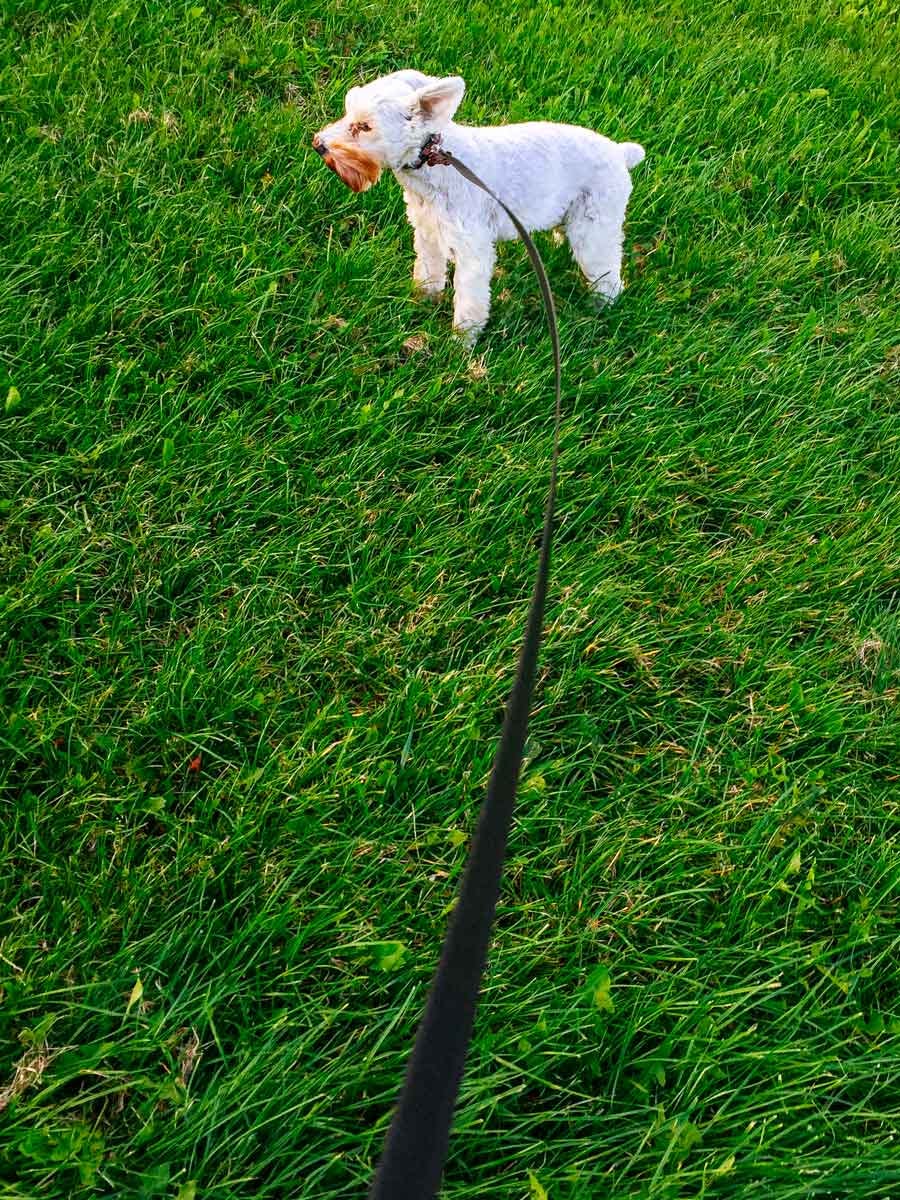
There’s not much to slow down the Baltic Sea winds as they travel the 12 miles (15 km) to Słupsk. The curve in the leash was caused by those winds.
Those first trips taught us that traveling by car in Poland is time-consuming. During our time in the country, most of the roads were two-lane ~ think blue highways if you’re an American ~ and the speed limits were appropriate for those kinds of roads. For example, it took us over two hours to drive the 60 miles from Słupsk to Gdansk. We quickly realized it was much more efficient, safe, and relaxing to travel by train to the larger cities in Poland (Wrocław, Warsaw, Kraków, Poznań, etc.) and by plane to international destinations.
In addition, we learned that traveling with a dog introduces constraints. Since a dog must be walked, fed, and can’t be kept in a travel crate for the entire day, we had to be aware of how much time had passed when we went out, limiting the types of activities we could do.
So, even though traveling with Riesy was one of our goals, reality interceded. We finally decided that kenneling her when we traveled was better for all. One of Rosemary’s colleagues recommended a lovely Polish couple who lived in a nearby village. Technically, Riesy was “in a kennel” (the couple bred Dobermans), but the reality was that she stayed in the main house, curled up on a pillow, right next to the people. While we missed her, we knew that she was well taken care of.
To recap: we had four goals when we moved to Europe:
to travel widely throughout Europe;
to share our adventures through a travel blog;
to learn some Polish and German; and
to bring Riesy (our dog) along whenever possible
How did we do? We accomplished the first two, barely made a dent in the third, and bowed to reality for the fourth. Overall, I think we did just fine.
Even though we opted not to “bring the dog,” many other travelers brought their dogs on their European travels.
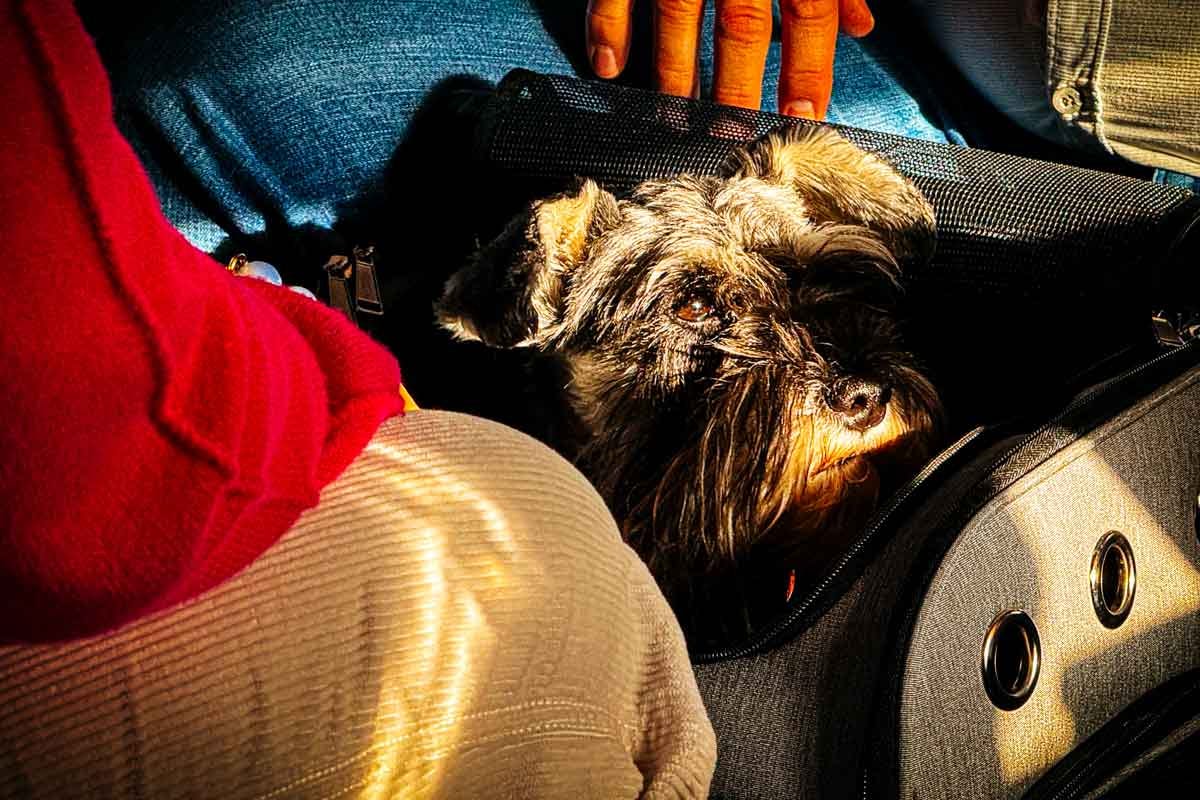
While Riesy never traveled by train, this handsome dog, who was uncharacteristically quiet for a mini schnauzer, made the trip from Karlsruhe to Paris. Whether she/he was going on vacation or going home, I’ll never know.
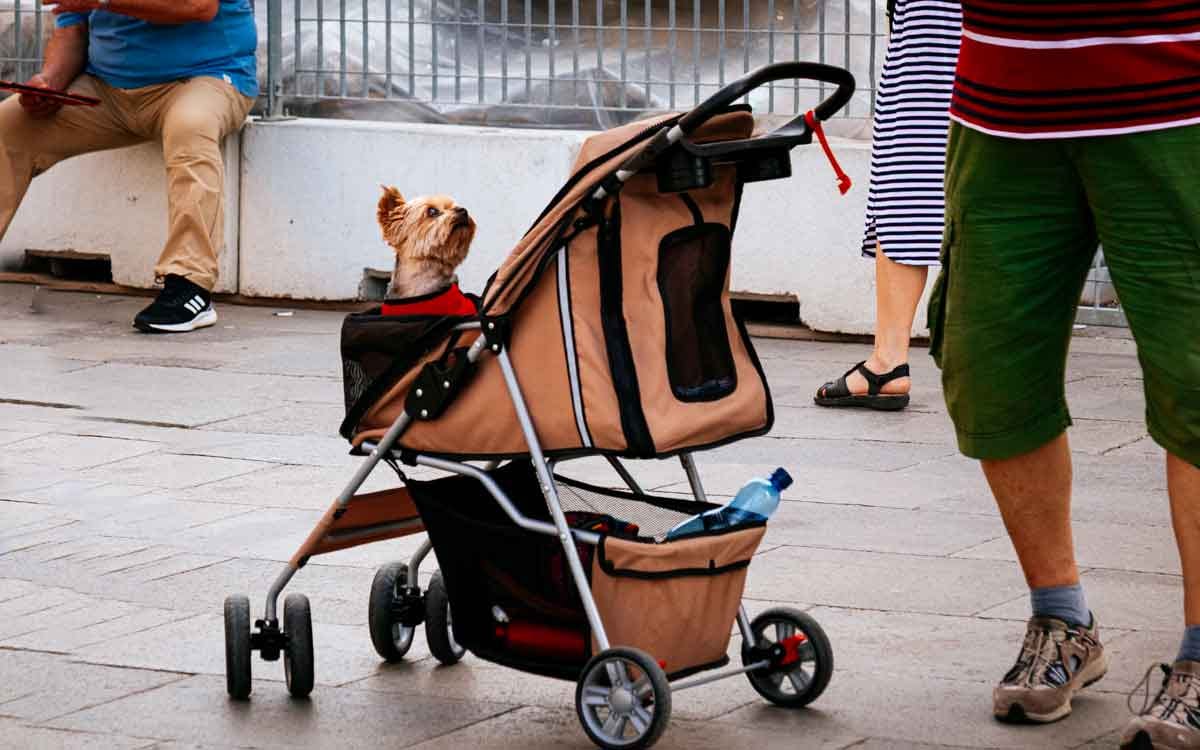
This lucky pup joined their people outside St. Mark’s Cathedral in Venice. I overheard the people talking and realized that they were Polish.
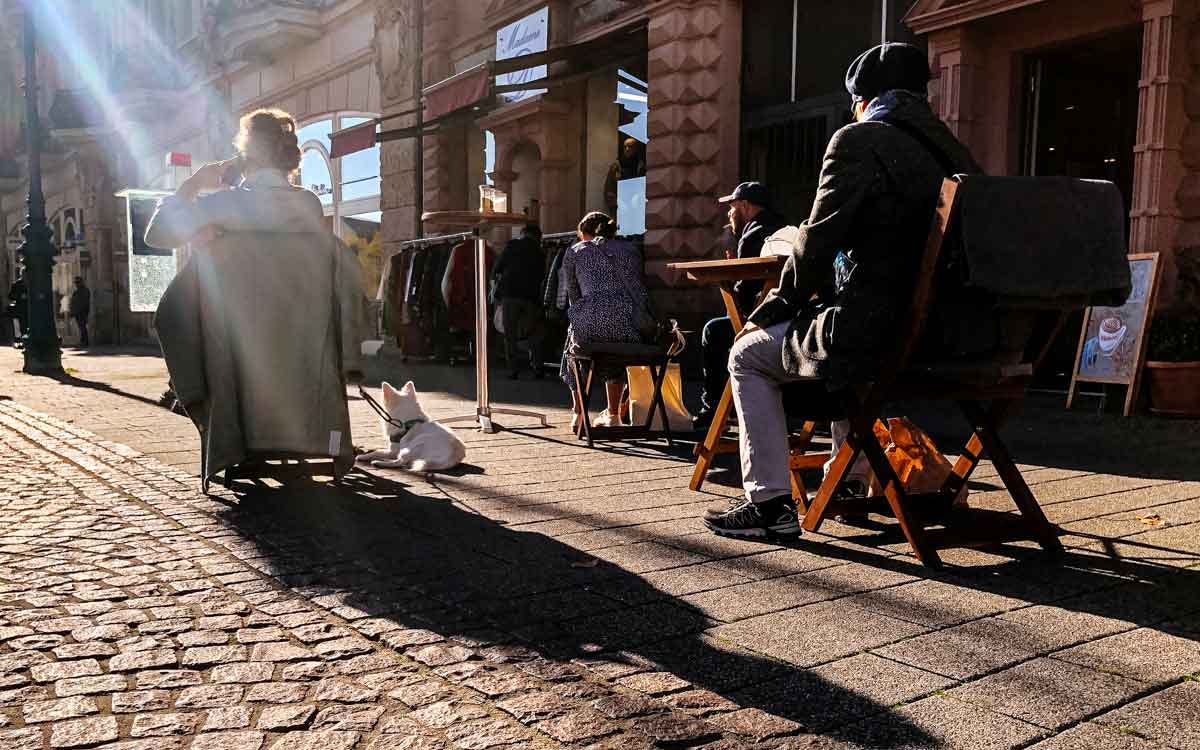
his lucky dog made the trip to the local coffee shop.
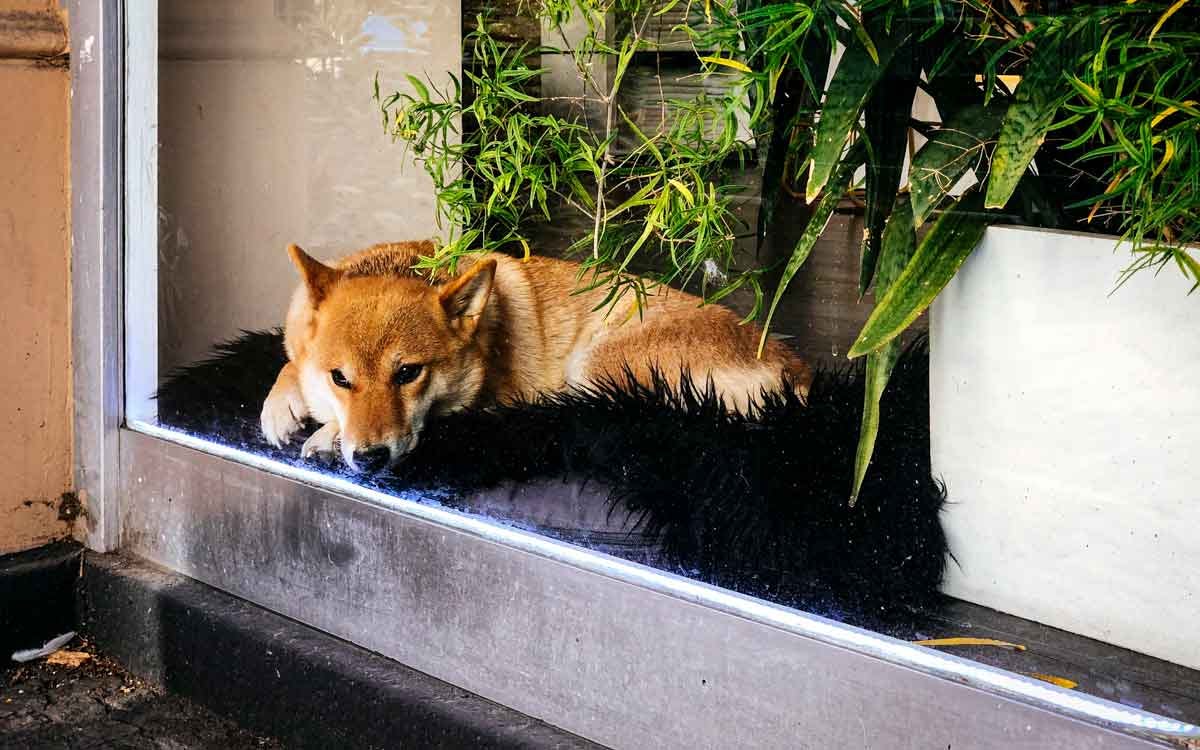
This dog traveled only as far as its person’s workplace, where she watched the world go by from the comfort of her dog pillow. Back in Louisville before we moved to Europe, Riesy and her brother made the daily trip upstairs to my home office.
I’ll end this short tale with a tale of longer tails.
On our first visit to Cologne, we met a standard schnauzer in front of the cathedral. I remember this particular schnauzer because she had a natural (undocked) tail. We had never seen a schnauzer with a natural tail. During our time in Europe, every schnauzer we saw had a natural tail. The natural tails were so expressive that our current Texas Pups have them.
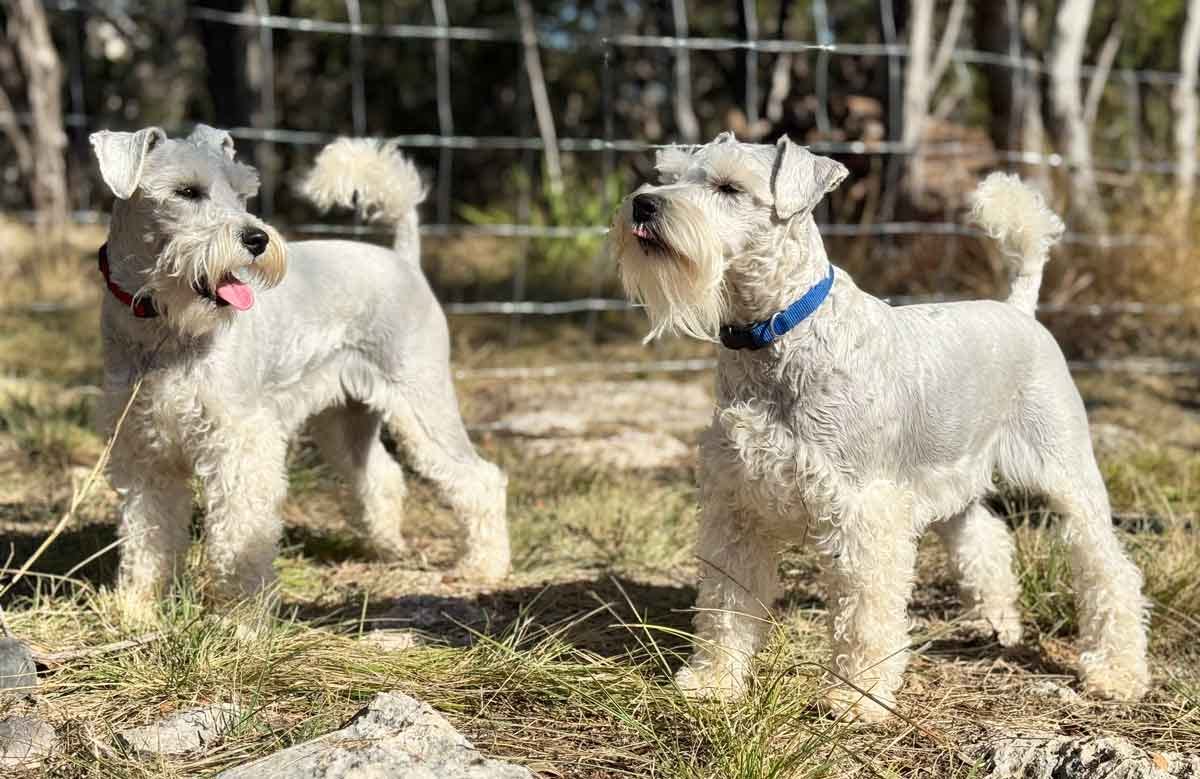
The Texas Pups say “howdy.”
Next time, I’ll share some favorite memories. Until then ~
Cheers!
Woof!